

Preface
This is the final entry in this series. The previous three installments fully documented my entire process: from the mistaken transfer and the initial rejected appeal, to reconnecting with Binance customer service in May 2026 to submit a recovery ticket, discovering BEVM’s rebranding to GEB, the old browser domain becoming invalid, testing the chain’s network status, and verifying transaction records using the new domain.
After a year and a half of back-and-forth communication, repeatedly supplementing evidence, prepaying a 20 USDT fee as required by the platform, multiple follow-ups with the project team to verify the chain’s operational status, and updating my wallet network configuration, I finally received an email from the platform in the early hours of June 18, 2026. The manual review, which lasted over a month, outright rejected the application without a specific reason, citing only “Other.” After a long and fruitless ordeal, I have decided to completely give up on this 0.00399895 BTC. I am writing this final retrospective to provide a comprehensive reference for all traders who encounter similar wrong-chain deposits.
1. Condensed Timeline of the Incident (Connecting the Previous Three Articles)
- 2025.01.22 – Incident Occurs
I originally intended to deposit BTC to Binance via the BSC (BEP20) network. I first copied the BTC deposit address for the BSC chain from the Binance platform, then manually switched to the BEVM Canary (Chain ID: 1501) network in my MetaMask wallet to make the transfer. I pasted the Binance BSC deposit address directly, resulting in a transfer error caused by manually selecting the wrong chain. Transaction hash:0x973a64e163d31128c70cff04b5b026521cbbc988012feb5ab3e4d1066a7e9f80. The 0.00399895 BTC was confirmed on the BEVM chain, but no assets were ever credited to my Binance account. My first self-service appeal failed, and the platform rejected it outright because it could not retrieve BEVM transaction records across chains. - 2026.05 – Resuming the Appeal
A year and a half later, I reviewed the incident and found that the BEVM project had undergone a comprehensive upgrade and rebranded to GEB. The originalbevm.iodomain block explorer was completely inaccessible. I abandoned the self-service form and proactively contacted Binance customer service. I provided my UID, transaction hash, and wallet transaction screenshots. I proactively explained that it was my own operational error: using the BEVM Canary network and entering a BSC deposit address for the transfer. I simultaneously submitted GEB’s official documentation to corroborate the project’s rebranding. - 2026.05.19 – Officially Submitting the Recovery Application
As required by customer service, I pre-deposited a 20 USDT recovery fee into my spot account. The customer service representative helped submit an asset recovery ticket with the application ID: CxF71HHq3IUaUjpI14o8. The platform stated that the initial review would take an estimated 2 business days, and the overall fund processing cycle would take more than 30 business days. The page identified the deposit network as BEVM. - 2026.06 – Discovering a Major Refund Risk and Continuously Supplementing Evidence
The platform stated that it only supported a same-chain refund via the original BEVM path. However, the old domain browser and RPC were completely down, and I was worried that the assets would be locked on the chain and unoperable after the refund.
- I contacted the official GEB community, where administrators confirmed that the underlying BEVM Canary nodes were producing blocks normally, but it was independent of the GEB mainnet, with no asset migration plan;
- I tested the Chainlist chain height, which continued to update, proving that the underlying chain was not shut down, but the public services for regular users had completely failed;
- Community users suggested a domain replacement workaround: changing
bevm.iotogeb.network. The new browser link could open the transaction records normally, allowing for a complete verification of the transfer; - I updated my MetaMask network RPC and browser address using the new GEB domain configuration. I synchronized the full set of network change evidence to customer service, informing the platform that I could receive the assets normally after a refund via the original path.
- Binance’s backend independently fetched the BEVM chain block height to complete an independent on-chain data verification, and the ticket entered a deep case evaluation.
- 2026.06.18 – Appeal Rejected, Completely Ending the Appeal Process
In the early hours, I received an automated notification email from Binance. Clicking for details confirmed that the ticket review had failed. There was no detailed basis for the rejection; it was only broadly categorized as “Other.” The 20 USDT fee was not deducted, and the platform’s remarks only prompted me to contact customer service for details. After weighing the situation repeatedly, I decided not to continue the appeal and to forfeit these assets.
2. Full Disclosure of the Rejected Ticket Information
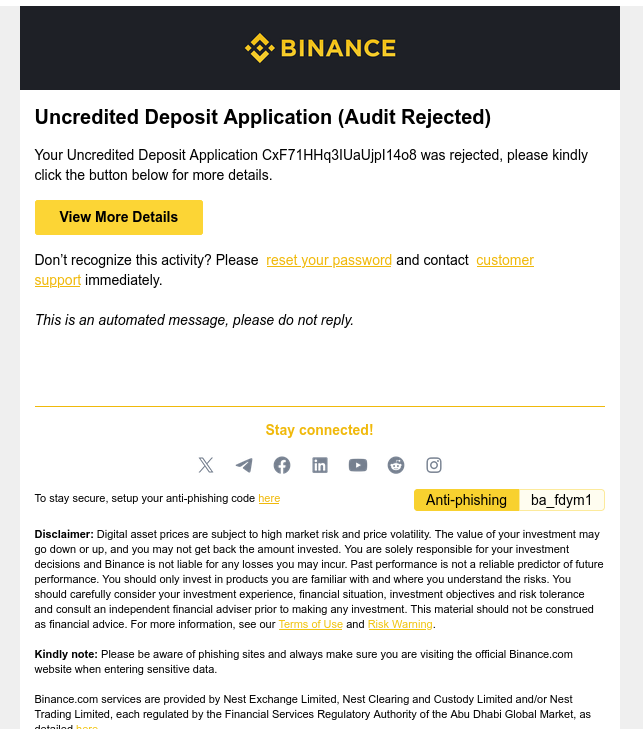
Original Email Notification
Uncredited Deposit Application (Audit Rejected)
Your Uncredited Deposit Application CxF71HHq3IUaUjpI14o8 was rejected, please kindly click the button below for more details.
View More Details
Don’t recognize this activity? Please reset your password and contact customer support immediately.
This is an automated message, please do not reply.
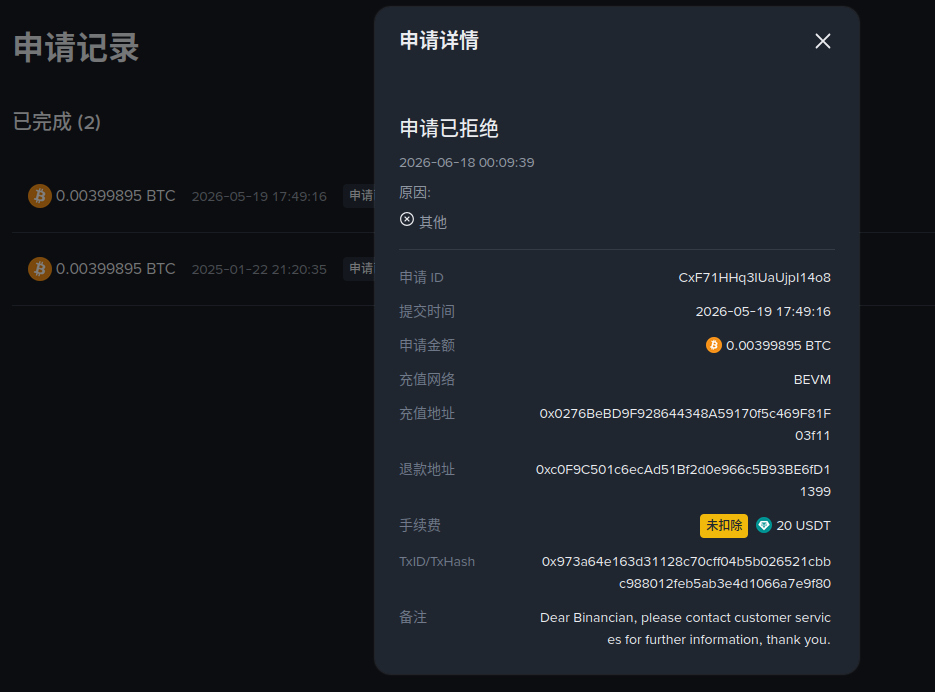
Ticket Details
- Application status: Application rejected
- Rejection time: 2026-06-18 00:09:39
- Rejection reason: Other
- Application ID: CxF71HHq3IUaUjpI14o8
- Submission time: 2026-05-19 17:49:16
- Application amount: 0.00399895 BTC
- Deposit network: BEVM
- Deposit address: 0x0276BeBD9F928644348A59170f5c469F81F03f11
- Refund address: 0xc0F9C501c6ecAd51Bf2d0e966c5B93BE6fD11399
- Recovery fee: 20 USDT (not deducted)
- TxID/TxHash: 0x973a64e163d31128c70cff04b5b026521cbbc988012feb5ab3e4d1066a7e9f80
- Official remarks: Dear Binancian, please contact customer services for further information, thank you.
3. A Complete Chain of Evidence Still Cannot Pass the Review
I am fully aware that the root cause of this incident lies in my own operational negligence. However, throughout the entire appeal period, I organized, retained, and submitted all supporting materials; there was no lack of evidence or ambiguity of information:
- Complete screenshots of the MetaMask wallet transfer, including the transfer time, amount, Chain ID, transaction hash, and on-chain confirmation status;
- Screenshots of the old BEVM browser error, and the complete transaction page on the new
geb.networkdomain browser, clearly showing the sending and receiving addresses, BTC amount, and Gas information; - Screenshots of the real-time block height of BEVM Canary on the Chainlist website, proving that the underlying chain continues to produce blocks;
- Chat records from the official GEB community, including official responses from project administrators regarding the chain’s operational status and the lack of an asset migration plan;
- Comparison screenshots of the old and new MetaMask network configurations, showing the updated valid RPC and browser addresses;
- Screenshots of the entire customer service communication process, ticket flow records, and the platform’s backend page for independent block height verification;
- Links to official documentation regarding BEVM’s rebranding to GEB, corroborating the project’s domain and brand change.
The facts are clear and verifiable: I manually switched to the niche BEVM testnet and entered a BSC deposit address, causing the funds to enter the platform’s address on the BEVM chain. The chain itself was not abandoned; after the domain change, it could be queried and operated normally, meaning there was no risk of assets being locked during a refund via the original path. Throughout the process, I proactively admitted my operational error, cooperated with all of the platform’s procedural requirements, prepaid the fee, supplemented various materials, and proactively provided verification channels. Ultimately, the review rejected my application with only the vague reason of “Other,” without any detailed technical or evidence-based explanation. The experience was extremely frustrating.
4. The Most Frustrating Aspects of the Whole Ordeal
- Rigid Rules, Lacking Flexibility for Individual Cases
The platform has a uniform rule that wrongly deposited assets can only be returned via the original path on the same chain, completely ignoring special scenarios such as niche testnets, project rebranding, and domain failures. Even though I provided complete evidence proving I could receive funds normally after updating my network configuration, and their backend had independently verified the on-chain data, they still refused to make an exception. - Vague Rejection Reasons, No Transparent Review Standards
After spending over a month on manual review, they ultimately only marked it as “Other” without informing me of the specific sticking point. Users cannot tell whether it was a technical limitation of the chain, an internal process issue, or some other hidden requirement. There was not even a direction for supplementing materials or filing a second appeal. - Customer Service Can Only Relay Information, Lacks Decision-Making Authority
Throughout the process, I interacted with multiple human customer service representatives. They could only record and forward requests, without the ability to intervene in the refund review department’s conclusions. Multiple communications only resulted in repeated scripted responses, unable to escalate for a specialized solution regarding the unique circumstances of a niche, obscure chain. - Severely Disproportionate Time Costs
From my own operational error in early 2025 to repeatedly following up, gathering evidence, liaising with the project team, and modifying wallet configurations in 2026, I invested dozens of hours over a year and a half. In the end, the appeal was directly voided, and all that time and energy became sunk costs.
5. Final Decision: Completely Giving Up, No Further Appeals
I know the root cause of the mistake lies with me. Originally, I planned to contact customer service again to ask for specific reasons and supplement materials for a second appeal if the review was rejected. After comprehensive consideration, I chose to cut my losses:
- The asset amount is small, and the return on continued investment of time and energy is extremely low;
- The platform’s review standards are opaque. Even if I submit another ticket, there is still a possibility of an unjustified rejection;
- BEVM Canary is a niche canary testnet. Exchanges inherently assign very low priority to recovery for wrong deposits on obscure networks. Repeated communication will most likely just yield the same result;
- I have retained a complete record of the incident as a personal cautionary tale, and will no longer invest additional costs in pursuing this.
6. Comprehensive Pitfall Summary and Advice for All Crypto Traders
Based on my complete experience over the past year and a half, I have compiled a few of the most practical lessons to help others avoid making the same mistakes:
- Strictly Distinguish Between Mainnets, Canary/Testnets; Chain ID is the Only Determining Standard
Multiple chains under the same project are independent of each other, and assets are not interoperable. Do not judge the network solely by the project name. Double-check the Chain ID, RPC, and browser domain before transferring. Niche chains are highly prone to domain changes and node failures. This incident is a classic example: manually switching to the wrong BEVM testnet and reusing a BSC address directly caused the loss. - Recovery Success Rate for Wrong Deposits on Obscure Niche Chains is Extremely Low
Exchange asset recovery resources are heavily prioritized toward mainstream public chains (BSC, ETH, TRC20, etc.). For niche testnets like BEVM, even if you fully admit your operational error and have complete evidence, manual reviews can easily reject it. Be absolutely cautious before operating. - Triple-Check Before Transferring: Address, Coin, and Network are All Indispensable
EVM-compatible chain address formats are identical, making it easy to copy an exchange mainnet address and switch to another niche chain for the transfer. Before transferring, confirm that the wallet’s current Chain ID exactly matches the exchange’s deposit network. Prioritize small test transfers. - Once a Wrong Deposit Occurs, Retain a Full Set of Evidence Immediately
Take screenshot backups of wallet transactions, block browser pages, official project announcements, and community communications. When a project rebrands or changes domains, immediately gather materials corresponding to both the old and new networks; this is the core support for an appeal. - Keep Expectations Low for Wrong-Chain Recovery, and Prepare for Loss
Even if the platform charges a recovery fee and helps submit a ticket, it does not guarantee that assets will be recovered. The fee is merely a procedural threshold, not a recovery guarantee. For small amounts, it is advisable to weigh the time cost beforehand and cut losses promptly. Even if the fault is your own, it is very difficult to recover assets through an appeal. - Self-Service Forms Have Major Limitations; Go Directly to Human Customer Service for Obscure Issues
The platform’s self-service recovery form only allows entering a TxID. Special scenarios like cross-chain or project rebranding cannot be fully explained. Escalate directly to human customer service, fully state the cause and effect, and attach all evidence to increase the ticket’s priority.
7. Final Words
With this, the year-and-a-half-long saga of appealing a wrong-chain BEVM Canary deposit, caused by my own operational negligence, officially comes to an end. The 0.00399895 BTC is permanently lost. It cannot be called a massive loss, but the twists and turns of the process and the platform’s opaque review handling truly leave one speechless.
I do not shy away from the fact that the root cause was my own mistake of switching networks and mixing up addresses. However, actively cooperating with all of the platform’s requirements and providing a full set of verifiable evidence throughout the process, only to receive an unexplained rejection in the end, inevitably breeds disappointment.
I wrote these four complete records partly to retain my own pitfall experience as a warning, and partly to provide a comprehensive practical reference for any user who mistakenly deposits to the wrong chain, especially on obscure niche networks. Blockchain transfers are irreversible, and exchange recovery for wrong deposits does not come with a 100% guarantee. The safest approach is always to double-check before transferring and prevent mistakes at the source.
I will no longer follow up on this ticket or contact customer service for further appeals. This article is the final entry in this series, and there will be no further updates on this matter.