

I. Experiment Background
After completing several rounds of WordPress optimization, I made a key adjustment to the site:
- Old theme: Hueman
- New theme: Twenty Twenty-Five (official WordPress 2025 theme)
Site scale:
- Approx. 2000+ articles
- 18,000+ tags
- Chinese + English bilingual structure
Test objectives:
Quantify the impact of the theme switch on site performance and establish baseline data for the upcoming CDN deployment.
II. Old Theme Hueman Performance (Baseline Data)
🌐 Domestic Testing (boce)
📊 Core Data:
- Average response time: 4.493s
- Fastest node: 0.07s
- Slowest node: 10s
- Telecom average: 4.359s
- Mobile average: 5.198s
- Unicom average: 3.833s
👉 Characteristics:
- Significant variance across ISPs
- Access latency in some regions reaches the 10-second level
🌍 Overseas Access (WebPageTest)
📊 Core Metrics:
- TTFB: 1.499s
- FCP: 2.706s
- LCP: 3.106s
- CLS: 0.127
- Speed Index: 3.353
- Fully Loaded: 12.73s
- Requests: 101
🧠 Problem Analysis:
1️⃣ High request count (101)
→ Excessive resource fragmentation
2️⃣ High LCP (3.1s)
→ Slow first-screen rendering
3️⃣ Long fully loaded time (12.7s)
→ Long JS / CSS / font loading chains
For more data, please refer to: WordPress Performance Benchmarking and CDN Selection Record: From Domestic Testing to Overseas WebPageTest, How a 1-Core 2GB Server Targets the Globe
III. New Theme Twenty Twenty-Five Performance
📸 Figure 1: boce nationwide speed test results
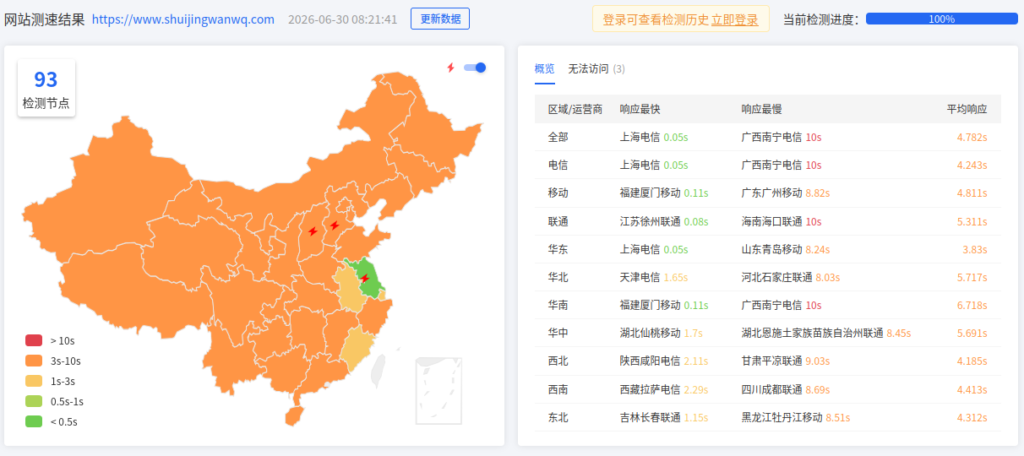
📊 Domestic Access Performance:
- Average response: 4.78s
- Telecom: 4.24s
- Mobile: 4.81s
- Unicom: 5.31s
- Slowest node: 10s
🧠 Interpretation:
- Domestic access is still largely affected by the network structure
- Theme optimization has limited impact on the domestic network
📸 Figure 3: WebPageTest Overview
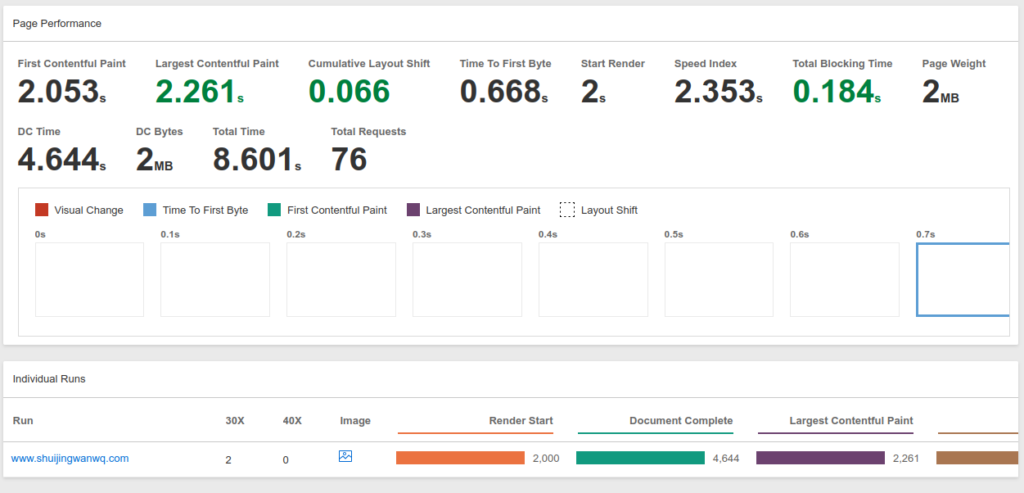
🌍 Core Metrics:
- TTFB: 0.668s
- FCP: 2.053s
- LCP: 2.261s
- CLS: 0.066
- Speed Index: 2.353
- Total Load: 8.601s
- Requests: 76
🧠 Analysis:
✔ TTFB (0.668s)
→ Now in the excellent range (<1s)
✔ LCP (2.26s)
→ Meets Google’s recommended standard (<2.5s)
✔ CLS (0.066)
→ Excellent page layout stability
✔ Request count decreased (101 → 76)
→ Theme structure is noticeably more lightweight
📸 Figure 4: Request Table Analysis
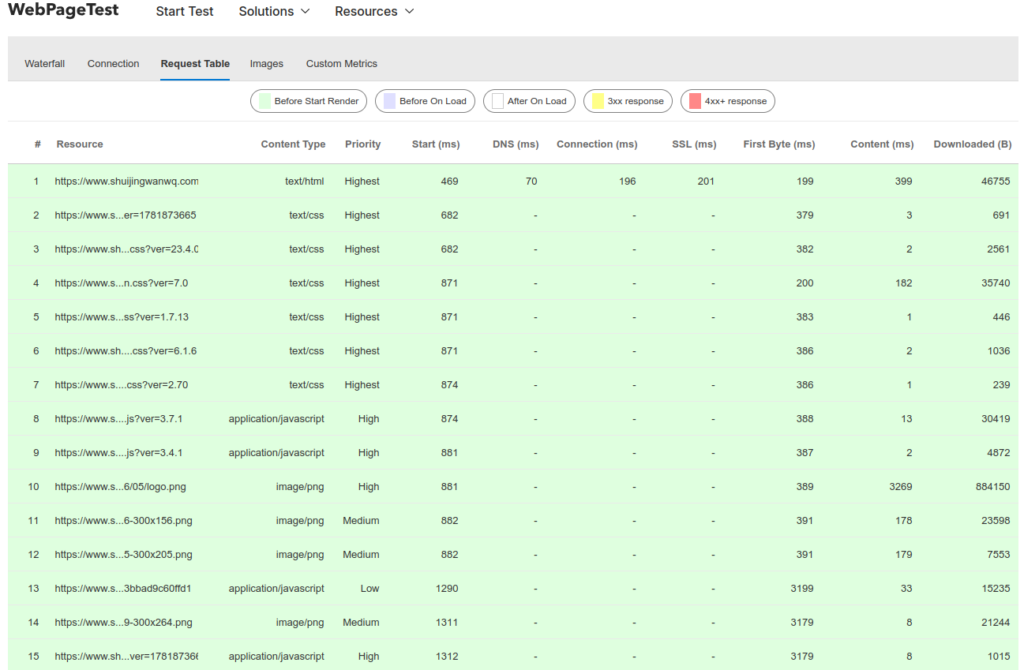
🧩 Resource Structure Changes:
- Reduced CSS count
- Fewer JS calls
- More consolidated font loading
- Clearer image loading paths
👉 Notes:
The page resource chain has been significantly optimized
🌊 Network Loading Path Analysis (Based on Request Table)
This analysis reconstructs the resource loading path based on the Request Table:
- HTML first byte at approx. 0.7s
- CSS / JS load in parallel
- Font resources incur independent connection overhead
- Image resource loading is scattered
- Total request chain involves about 70–100 resources
👉 Conclusion:
The page performance bottleneck is primarily concentrated on “resource count + network round-trips,” rather than server processing power
IV. Hueman vs Twenty Twenty-Five Comparison
| Metric | Hueman | Twenty Twenty-Five | Change |
|---|---|---|---|
| TTFB | 1.499s | 0.668s | 🔽 Significantly optimized |
| LCP | 3.106s | 2.261s | 🔽 Noticeably optimized |
| CLS | 0.127 | 0.066 | 🔽 More stable |
| Load Time | 12.73s | 8.60s | 🔽 Greatly optimized |
| Requests | 101 | 76 | 🔽 Reduced by 25% |
| Speed Index | 3.35 | 2.35 | 🔽 Faster |
V. Core Conclusions
🧠 1️⃣ Theme optimization effects are significant
From Hueman → Twenty Twenty-Five:
- Faster first-screen loading
- Reduced request count
- Shorter rendering path
- Lighter page structure
👉 Conclusion:
The official WordPress 2025 theme clearly outperforms the old Hueman theme in terms of performance
🧠 2️⃣ The current bottleneck has shifted
Before optimization:
Server performance + theme structure issues
After optimization:
🌍 Network distribution + global access latency issues
🧠 3️⃣ Necessity of CDN deployment
Current status:
✔ Optimized areas:
- TTFB is already excellent
- LCP meets the standard
- CLS is already excellent
❗ Unresolved issues:
- Overseas Load Time is still 8s+
- High variance across domestic ISPs
- Resources still all fetch from the origin server
👉 Conclusion:
A CDN has entered the “necessary phase,” rather than being an “optional optimization”
VI. Next Steps for CDN Experimentation
This data serves as:
📌 Pre-CDN baseline data
Next steps will involve:
🚀 Step 1: Integrate Cloudflare CDN
- DNS switch
- Static asset caching
- bypass wp-admin
🚀 Step 2: Repeat Testing
Keep exactly the same:
- Same page
- Same WebPageTest node (Ohio)
- Same boce configuration
🚀 Step 3: Comparative Analysis
Focus on observing:
- Whether TTFB decreases
- Whether LCP improves
- Whether domestic access is affected
- Whether Fully Loaded time decreases
VII. Tool Notes (Optional Affiliate Marketing Point)
Tools used in this test:
- WebPageTest (overseas real browser simulation)
- boce website speed test (domestic multi-node testing)
👉 Involved in the CDN plan:
- Cloudflare (pending deployment verification)
VIII. Summary
This test completed a key phase of WordPress optimization:
✔ Theme optimization is complete
✔ The performance bottleneck has shifted from “server/theme” to “CDN distribution”
🧠 One-Sentence Summary
WordPress front-end performance has entered a stable phase, and the next optimization space is focused on the CDN and global distribution network.