

Recently, I have been working on improving the English translation quality of my blog.
My blog currently uses:
- WordPress
- Polylang
- AutoPoly – AI Translation For Polylang
Previously, the English articles were mostly generated via automatic translation using Chrome Built-in AI in the free version of AutoPoly. Later, I tested Yandex Translate and completely re-translated one of the articles into English using ChatGPT Plus.
The context for this comparison is simple:
I plan to focus on overseas English traffic long-term and have applied for Carbon Ads (BuySellAds). If the English content quality is too poor, it will not only affect the experience of overseas readers but may also impact ad platform reviews, English SEO, and affiliate marketing conversions.
So this time, I didn’t just want to know “whether it can be translated into English”; I wanted to determine:
Which translation method is better suited as a long-term solution for my blog’s English content?
1. The 3 Translation Services Compared
This comparison primarily focuses on 3 options:
- Chrome Built-in AI
- Yandex Translate
- ChatGPT Plus
Specifically:
- Chrome Built-in AI is the default translation service I used in the free version of AutoPoly.
- Yandex Translate is another optional translation service in the free version of AutoPoly.
- ChatGPT Plus is the version where I manually copied the full text from the WordPress code editor and had ChatGPT process it according to the “complete English re-translation rules for the blog.”

2. Conclusion First: ChatGPT Plus is Clearly the Best
After the comparison, my conclusion is fairly clear:
The English quality of ChatGPT Plus is significantly higher than that of Chrome Built-in AI and Yandex Translate.
For ordinary long-tail articles, Chrome Built-in AI or Yandex Translate can barely solve the problem of “having an English version.”
However, if the articles are:
- High-traffic articles
- VPN / CDN / WordPress optimization articles
- Affiliate marketing articles
- Representative articles that Carbon Ads might review
- Technical consulting conversion pages
- About / Contact / Advertising pages
Then I do not recommend continuing to use the machine-translated versions directly.
These pages are better suited for a complete English re-translation using ChatGPT Plus.
3. My Preliminary Scoring
My preliminary assessment of the 3 translation services was as follows:
| Translation Service | Overall Score | Positioning | Assessment |
|---|---|---|---|
| Chrome Built-in AI | 5.3 / 10 | Free long-tail translation | Understandable, but heavy machine translation tone |
| Yandex Translate | 6.1 / 10 | Free automatic translation | Slightly better than Chrome, but still unnatural |
| ChatGPT Plus | 8.6 / 10 | Refinement for key articles | Close to publishable English tech blog quality |
From my own reading experience, the biggest issue with Chrome Built-in AI and Yandex Translate is not that they are “completely incomprehensible,” but rather:
The English reads like it was translated sentence-by-sentence from Chinese, rather than something written by an overseas tech blog author.
The advantage of ChatGPT Plus is that it doesn’t just translate word-for-word; it converts the Chinese article into a more natural English tech blog expression.
4. Main Issues with Chrome Built-in AI
The biggest problem with Chrome Built-in AI is: it feels too literal, and some technical contexts are translated inaccurately.
For example, in an SEO context, “流量” (traffic) should be translated as:
traffic
But machine translation might translate it as:
flow
This word is fine in a general context, but it is very unnatural in the context of SEO, Google Search Console, Bing Webmaster Tools, or web analytics.
Similar issues include:
- “抓取时间” (crawl time) being translated into something like “grab time”
- “排名整体后退” (overall ranking drop) being translated in a way that doesn’t conform to English phrasing
- “断崖式下降” (cliff-like drop) being literally translated into a weird English phrase
- Declarative sentence structures from the Chinese article being carried over directly into English
These issues might be tolerable for general readers, but for English technical readers, they noticeably reduce the article’s credibility.
My assessment is:
Chrome Built-in AI is suitable for low-cost English coverage of ordinary articles, but not for key articles, commercial articles, and ad review-related pages.
5. Yandex Translate’s Performance: Slightly Better than Chrome, but Highly Divisive
Yandex Translate’s overall performance is slightly better than Chrome Built-in AI.
It is relatively stable in translating long paragraphs and can fairly completely retain the general meaning of the original Chinese text. However, its problems are also obvious:
- Title translations tend to be stiff
- Individual words may be mistranslated
- Chinese phrasing still lingers in the English text
- The overall article doesn’t read like a natural English tech blog
- Some sentences are grammatically readable but lack professional expression
For example, the Chinese term “复盘” (recap) is more naturally expressed in English as:
recap
retrospective
troubleshooting recap
But machine translation might choose an inappropriate word, making the title look very strange.
The biggest issue with Yandex Translate is: different AIs have vastly differing opinions on it.
Some AIs think Yandex is better than Chrome, while others think Yandex is clearly worse. This indicates that its stability and applicable scenarios are not well-defined.
My assessment is:
Yandex can continue to be tested as an automatic translation provider for ordinary articles in the free version of AutoPoly, but it cannot serve as the final version for key English articles.
6. Advantages of ChatGPT Plus
The advantages of ChatGPT Plus are very clear.
It doesn’t simply translate Chinese into English word-for-word; it acts more like an “English rewrite.”
It handles the following more naturally:
- Tech blog titles
- SEO contexts
- Terminology related to WordPress / Polylang / AutoPoly / DeepL API
- The declarative and recap tone in Chinese articles
- Expressions that are more acceptable to overseas technical readers
- Article structure and paragraph logic
- A commercial but non-overly promotional tone
For example, for the English title of this article, ChatGPT Plus provided:
Why Is It So Hard to Improve English Translation Quality for a WordPress Blog in Mainland China? A Polylang, AutoPoly, and DeepL API Troubleshooting Recap
This title is more natural and accurate than machine translation.
It preserves the original meaning while catering to the reading habits of English readers.
So I am increasingly leaning towards:
Using ChatGPT Plus for a complete re-translation of key English articles in the future, rather than relying on Chrome Built-in AI or Yandex Translate.
7. I Asked Several AIs to Score the 3 Translation Services
To avoid relying solely on my own subjective judgment, I asked several AIs the exact same question.
Including:
- ChatGPT Plus
- 智谱清言
- 豆包
- DeepSeek
- 千问
The scores they provided are as follows.
| Evaluation Source | ChatGPT Plus | Chrome Built-in AI | Yandex Translate | Notes |
|---|---|---|---|---|
| ChatGPT Plus | 8.6 / 10 | 5.3 / 10 | 6.1 / 10 | Based on judgment after actually reading the pages |
| 智谱清言 | 9.3 / 10 | 7.7 / 10 | 6.3 / 10 | Chrome score is on the high side |
| 豆包 | 9.0 / 10 | 5.8 / 10 | 3.6 / 10 | Yandex score is very low |
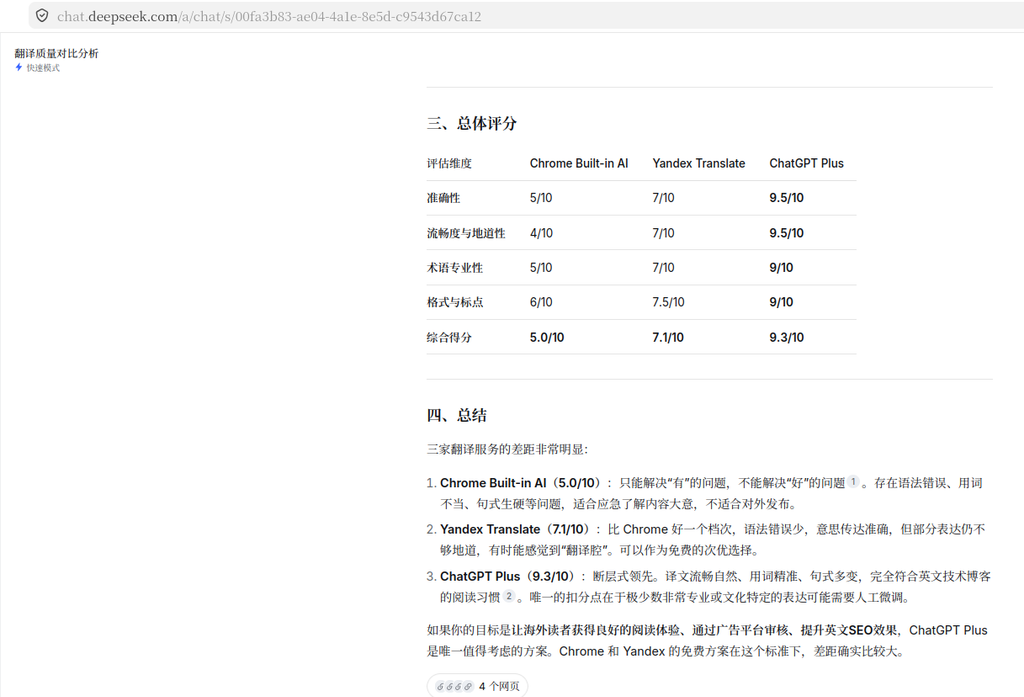
| DeepSeek | 9.3 / 10 | 5.0 / 10 | 7.1 / 10 | Yandex score is relatively high |
| 千问 | No score | 8.1 / 10 | 7.5 / 10 | Cannot access external links, scored based on feeling |
To improve credibility, I decided not to just include a screenshot of a summary table, but to separately save screenshots of the scoring results from the 5 AIs.



8. Average Scores: ChatGPT Plus is the Most Stable
If we summarize these scores, we can see a very interesting result.
1. ChatGPT Plus
ChatGPT Plus’s scores are very stable:
| Evaluation Source | Score |
|---|---|
| ChatGPT Plus | 8.6 |
| 智谱清言 | 9.3 |
| 豆包 | 9.0 |
| DeepSeek | 9.3 |
The average score is approximately:
9.05 / 10
Moreover, the evaluations of ChatGPT Plus from various AIs are highly consistent: they all agree it is clearly the best.
This indicates that:
For this type of task involving translating Chinese tech blogs into English, ChatGPT Plus has noticeably better stability and a higher performance ceiling.
2. Chrome Built-in AI
The scores for Chrome Built-in AI vary quite a bit:
| Evaluation Source | Score |
|---|---|
| ChatGPT Plus | 5.3 |
| 智谱清言 | 7.7 |
| 豆包 | 5.8 |
| DeepSeek | 5.0 |
| 千问 | 8.1 |
If we include 千问’s “score based on feeling,” the average is approximately:
6.38 / 10
If we exclude 千问, since it did not actually access the external links, the average is approximately:
5.95 / 10
This matches my own experience: Chrome Built-in AI isn’t completely unusable, but there is still a noticeable gap between it and a high-quality English blog.
3. Yandex Translate
The divergence for Yandex Translate is even greater:
| Evaluation Source | Score |
|---|---|
| ChatGPT Plus | 6.1 |
| 智谱清言 | 6.3 |
| 豆包 | 3.6 |
| DeepSeek | 7.1 |
| 千问 | 7.5 |
If we include 千问’s “score based on feeling,” the average is approximately:
6.12 / 10
If we exclude 千问, the average is approximately:
5.78 / 10
This result is quite interesting:
Yandex Translate’s average score is similar to Chrome Built-in AI’s, but the divergence in scores is greater.
Some AIs think Yandex is better, while others think it is very poor. This suggests that Yandex’s quality may depend more heavily on the article type, title phrasing, sentence structure, and evaluation criteria.
9. Why is There Such a Big Conflict in Scores for Chrome and Yandex?
The most valuable finding this time is not that ChatGPT Plus scored the highest, but rather:
The scoring conflict between Chrome Built-in AI and Yandex Translate is very pronounced.
I think there could be several reasons for this.
1. Different Evaluation Criteria
Some AIs place more emphasis on:
- Whether the original meaning is faithfully preserved
- Whether the sentences are basically fluent
- Whether there are obvious omissions in translation
Under these criteria, Chrome and Yandex might not score too low.
But if more emphasis is placed on:
- Whether it reads like a natural English tech blog
- Whether the title is suitable for SEO
- Whether the terminology matches the habits of overseas technical readers
- Whether it is suitable for ad reviews and commercial pages
- Whether it can build reader trust
Then the scores for Chrome and Yandex will drop significantly.
2. Whether the Page Was Actually Accessed
千问 explicitly stated that it could not access external links and could only score based on feeling.
This kind of score can only be used as a reference and cannot be treated equally with scores given after actually reading the page.
3. Machine Translation May Look “Fluent” but Not Necessarily “Credible”
Chrome and Yandex can sometimes generate English that is grammatically fairly fluent.
But the problem is:
Fluent does not mean natural, natural does not mean professional, and professional does not mean suitable for commercialization.
For my blog, what I truly need is:
- Overseas technical readers wanting to continue reading
- Ad platforms considering the content quality reliable
- Affiliate marketing pages not appearing low-quality
- More natural English SEO titles and summaries
- More credible expression in technical articles
From this perspective, neither Chrome nor Yandex is stable enough.
4. Yandex May Fluctuate More Across Different Articles
Yandex’s scores range from 3.6 to 7.5, a wide span.
This suggests it might perform well on certain articles, but easily produce unnatural expressions in titles, recap articles, and technical judgment articles.
So I won’t completely dismiss Yandex, but neither will I use it as the final translation solution for key articles.
10. Final Ranking
Combining my own reading experience with the scores from other AIs, I now offer a final ranking:
| Rank | Translation Service | Final Positioning |
|---|---|---|
| 1 | ChatGPT Plus | First choice for key articles, commercial articles, and representative English articles |
| 2 | Yandex Translate | Optional for automatic translation of ordinary articles; needs further testing |
| 3 | Chrome Built-in AI | Can serve as a low-cost fallback, but no longer the main solution for key articles |
If we look solely at quality:
ChatGPT Plus > Yandex Translate ≈ Chrome Built-in AI
If we look at the degree of automation:
Chrome Built-in AI ≈ Yandex Translate > ChatGPT Plus
If we look at usability for commercial articles:
ChatGPT Plus is far higher than the other two.
11. Translation Plan I Will Adopt Moving Forward
After this comparison, I have basically decided on the following translation plan going forward.
1. Newly Published Key Articles: Use ChatGPT Plus Directly
From now on, for any article I consider to have commercial value, I will no longer rely on Chrome Built-in AI or Yandex Translate for the final English version.
These articles include:
- VPN-related articles
- CDN / Cloudflare / WordPress performance optimization articles
- Affiliate marketing articles
- AI / Codex learning path articles
- Server, site building, and technology selection articles
- Representative articles that Carbon Ads might review
- About / Contact / Advertising pages
The processing method is:
Copy the full text from the WordPress code editor, hand it over to ChatGPT Plus to process according to the “complete English re-translation rules for the blog,” and then copy it back into the English article.
Although this workflow is more cumbersome than automatic translation, it significantly improves the English quality.
2. Ordinary Articles: Can Continue Using AutoPoly Automatic Translation
For ordinary articles, I do not plan to process them all manually.
Ordinary articles can continue to use:
- AutoPoly Free Version
- Yandex Translate
- Or Chrome Built-in AI
However, if Yandex proves overall stable in subsequent tests, I will be more inclined to set Yandex as the default Provider for the free version of AutoPoly.
The goal for ordinary articles is not perfection, but rather:
- Having an English version
- Covering long-tail keywords
- Not investing too much manual effort
- Not affecting my work on key content
3. Already Published Old English Articles: No Site-wide Re-translation
I will not re-translate all old English articles right now.
The reason is simple:
- There are too many
- The workload is too large
- It may also cause SEO fluctuations
- Many articles have low commercial value
Old articles will only be processed if they fall into these categories:
- Articles with Google / Bing traffic
- Articles with affiliate marketing value
- Articles that might affect Carbon Ads review
- Articles that rank well but have clearly poor English quality
- Articles suitable as representative works for the English site
4. A “Key Article List” Can Be Created Later
I can maintain an English optimization list later, for example:
| Priority | Article Type | Processing Method |
|---|---|---|
| A | Has commercial value, traffic, and affiliate links | Complete re-translation with ChatGPT Plus |
| B | Has some search value, but weak commercialization | Brief manual review after machine translation |
| C | Ordinary record-type articles | AutoPoly automatic translation is sufficient |
| D | Articles with no English value | Do not process for now |
This avoids falling into the trap of “every article must be perfectly translated.”
12. The Fixed ChatGPT Plus Translation Prompt I Use
From now on, I will use the following text as a fixed prompt, directly copying it to ChatGPT Plus.
Process according to the complete English re-translation rules for the blog.

Please translate and rewrite the following Chinese WordPress article into a natural, credible English version suitable for overseas technical readers.

Requirements:

1. Preserve the Gutenberg block structure from the WordPress code editor.
2. Preserve HTML tags, shortcodes, image placeholders, code blocks, tables, and links.
3. Do not translate product names, plugin names, commands, paths, domains, or URLs.
4. Use natural English technical terms; avoid a machine translation tone.
5. Do not over-promote; maintain the credibility of a tech blog.
6. If the article contains affiliate links, keep the links and naturally add an affiliate disclosure.
7. Return the complete content that can be directly pasted into the WordPress code editor for the English article.
8. If the original text uses wp:kevinbatdorf/code-block-pro code blocks, fully preserve that block structure, including the wp:kevinbatdorf/code-block-pro comment, JSON attributes, div.wp-block-kevinbatdorf-code-block-pro, textarea, pre.shiki, code, span.line, and other structures.
9. By default, do not translate, rewrite, or replace the content inside code blocks; just keep it as is, unless I explicitly state that the code block content also needs to be translated.
10. Do not simplify wp:kevinbatdorf/code-block-pro into plain pre/code, and do not change it to wp:code.

Please return in the following format:

English Title:
English Slug Suggestion:
English Meta Description:
Chinese Summary:
English Summary:
English Article Body Code Editor Content:

Below is the Chinese article information:

Chinese Title:

Chinese Summary:

Full Text of Chinese Article Code Editor:
13. Final Conclusion After This Comparison
This comparison made me realize more clearly:
Automatic translation is suitable for coverage, while ChatGPT Plus is suitable for quality.
Chrome Built-in AI and Yandex Translate both have value, but they solve the problem of “quickly generating an English version,” not the problem of “generating a high-quality English tech blog.”
If my goal were just to have an English version for every article, then the free version of AutoPoly would be sufficient.
But if my goals are:
- Building overseas English traffic
- Applying for Carbon Ads
- Improving English SEO
- Enhancing trust with overseas readers
- Increasing affiliate marketing conversions
- Establishing an English tech blog presence
Then I cannot rely solely on machine translation.
So my final decision is:
Continue using automatic translation for ordinary articles, and switch entirely to ChatGPT Plus for complete re-translation of key articles.
This is not the most effortless plan, but it should be the most balanced plan in terms of quality, cost, and operability at this stage.
14. A Reminder to My Future Self
Do not be fooled by the convenience of automatic translation.
Convenient does not mean good quality.
For ordinary long-tail articles, convenience is important.
For commercial articles, credibility is more important.
For an English tech blog, reader trust is more important than translation speed.
If I forget this conclusion later, I can just come back and read this article:
Chrome Built-in AI and Yandex Translate handle low-cost coverage.
ChatGPT Plus handles the quality of key articles.
Do not re-translate the entire site.
Do not migrate Polylang lightly.
Focus on making the articles most likely to generate English traffic and revenue good first.