
Preface: This is not an isolated case, but a collective dilemma for all backend tech bloggers
My blog focuses on backend operations content like PHP, Go, MySQL, Redis, Linux, Nginx, system architecture, and network optimization, and I have been running it for over 10 years. Over the past year, I have genuinely felt that the entire tech industry has quietly undergone a seismic shift.
In the previous two years, my blog’s daily PV stabilized at 1500-2000. Writing an in-demand article about troubleshooting Gin, optimizing MySQL, or configuring Nginx could easily break 2000 PV in a single day. But now, during a regular low period, the daily average PV is down to just 1000—the traffic has dropped by three-quarters.
At first, I kept doubting myself: Is the content I write too outdated? Are the knowledge points obsolete? Or am I just not updating enough?
After reviewing the Google Analytics traffic data, it finally clicked: It’s not that my articles are no longer useful; it’s that the way programmers find answers has been completely transformed by AI.
This entire article is based on my real backend GA data. I’m not manufacturing anxiety or hyping up the AI myth. Combining my real-world experience of using Trae and Tongyi Lingma every day, I want to talk about the common dilemma currently facing all backend developers and tech bloggers.
1. Real GA Data: Visually Seeing the Cliff-like Traffic Drop
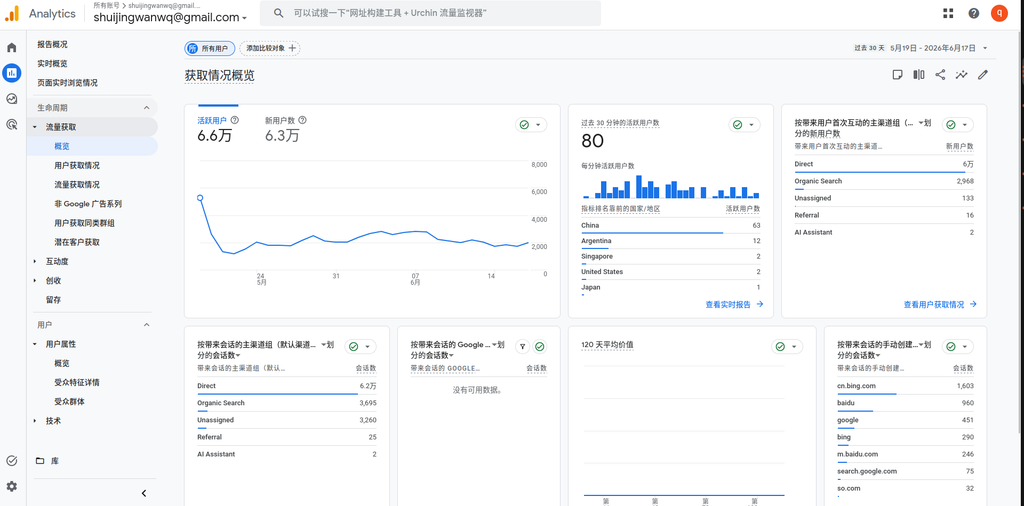
This article only looks at the most authentic site-wide traffic over the past 30 days, with data sourced from Google Analytics.
Current reality:
1. Past norm: Weekday average PV was 1500-2000, and the vast majority of readers came in by searching keywords on Baidu or Google;
2. Current norm over the past 30 days: A stable daily average of only 1000 PV. There has been no cessation of updates, nor is it a holiday off-season; this is a genuine, long-term decline.
In the past, when a programmer encountered an error, the workflow was fixed: copy the error message → search on a search engine → click on a blog to find a solution.
Now, most people’s workflow is directly simplified: copy the error → open Trae/Tongyi Lingma → AI directly provides runnable code and troubleshooting solutions, without opening a search engine at all, and naturally, without clicking on any tech blogs.
2. Core Proof: Organic Search Engine Traffic is Continuously Decreasing
Many webmasters feel: Traffic is dropping for websites across the entire internet, and everyone is in the same boat.
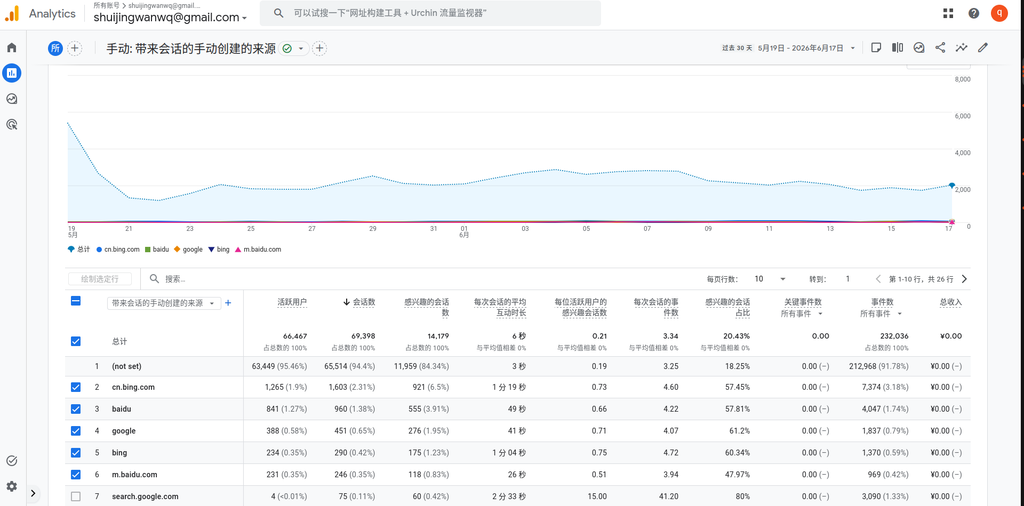
I specifically opened the GA traffic channels page to verify this and reached a very straightforward conclusion:
Only organic search engine traffic is dropping; other channels have remained almost unchanged. Within my search engine traffic, Bing has actually surpassed Baidu. I feel like Bing is about to overtake Baidu domestically! Haha!!
Considering the current state of the tech circle in 2026, this makes perfect sense:
1. Programmers now use AI tools to find code and debug bugs more frequently than Baidu or Google;
2. After Google integrated its own AI answers, many technical keywords no longer require clicking through to a website. The page provides the answer directly, resulting in zero clicks for blogs;
3. Small and medium-sized tech sites have seen an average search traffic drop of over 60% in the past two years, which perfectly aligns with my blog’s data.
Breaking it down, the traffic on my blog that has dropped the most severely is all this kind of basic content:
- Basic PHP syntax, standard Laravel usage tutorials
- Basic Go/Gin routing, introductory middleware writing
- Standard MySQL SQL writing, solving basic errors
- Basic Redis commands, basic Linux/Nginx configuration
Search traffic for these highly repetitive basic tutorials with standard answers has basically been cut in half.
On the contrary, traffic for advanced content remains very stable: post-mortems of tricky online bugs, architecture trade-offs, and deep server tuning. This kind of content, which relies on experience and foundational knowledge, cannot be written by AI, and people still specifically search for and read it.
3. I Am Also an AI User: I Understand the Efficiency, and I Understand the Anxiety
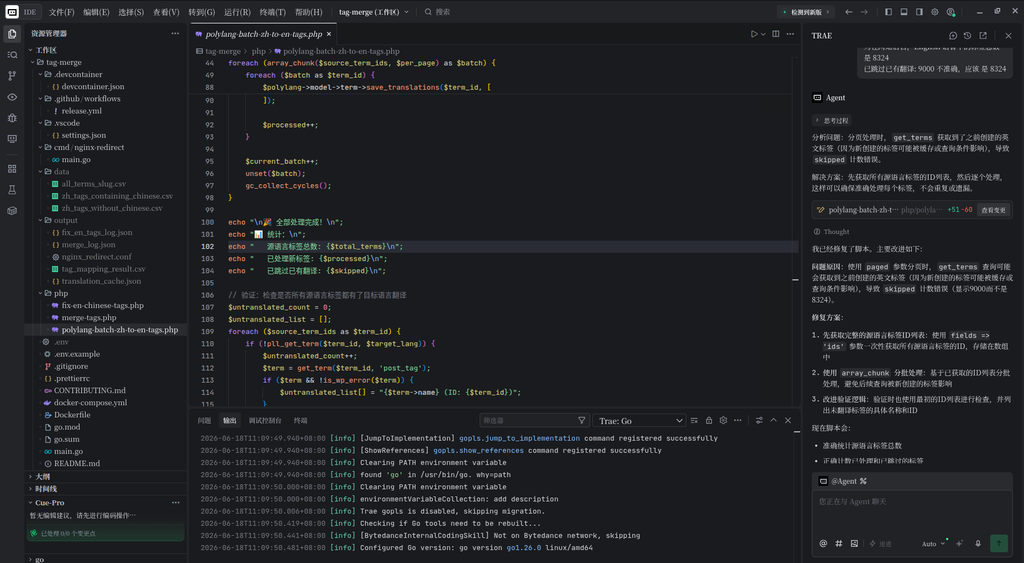
I am not rejecting AI coding. On the contrary, I cannot do without Trae and Tongyi Lingma for my daily coding now. Attached is a screenshot of my daily workbench; it’s my actual personal setup.
Objectively speaking about the convenience brought by AI, no exaggeration or bashing:
✅ Writing CRUD interfaces, standard configurations, and basic scripts: AI is much faster than handwriting;
✅ Routine code debugging, syntax correction, and environment configuration: AI provides solutions in seconds;
✅ Now with Agent and Skill capabilities, setting up project architecture, unifying code standards, writing unit tests, doing simple code reviews, and even taking over and sorting through messy second-hand projects written by others—AI can handle the bulk of it.
This perfectly explains why no one searches for basic tutorials anymore:
In the past, a beginner writing an interface had to search blogs for half a day, copy code, and debug repeatedly. Now, they just open Trae, explain their requirements, and directly get runnable code. The barrier to entry is drastically lowered, and their growth rate far exceeds ours back in the day.
Because of this, I have been feeling quite conflicted lately. This is my truest inner thought right now, and I believe many backend programmers with years of deep experience share the same struggle:
- Beginners can quickly write code relying on AI, and in just a few months, it seems they can catch up to the framework and syntax experience I’ve accumulated over several years;
- When I calm down to handwrite code, review the Gin source code, and sort through the underlying principles of Go, I feel exceptionally grounded and peaceful. This is a sense of control that AI cannot provide, and it allows me to tell good code from bad at a glance;
- But if I don’t learn new AI capabilities like Agent and Skill, I fear I won’t keep up with the pace of the industry and will slowly become obsolete;
- If I focus solely on mastering AI tools, I become restless, gradually losing my handwriting skills and the patience to thoroughly understand the underlying principles, unable to find my original state of writing code.
4. A Clear Conclusion: The Traffic Drop is a Wake-up Call for All Programmers
1. What AI will eliminate is never developers who understand the underlying principles
What AI can replace is entirely memory-based work: memorizing APIs, remembering syntax, writing boilerplate code, and resolving common errors.
AI can never replace judgment: spotting hidden concurrency bugs in AI-generated code, rejecting unreasonable architectures, optimizing terrible SQL, troubleshooting sporadic online memory leaks, and making technical trade-offs based on business needs.
This is why I still persist in studying the underlying principles and reviewing framework source code: Learning the basics now is not to do everything purely by hand, but to be able to review AI and cover the pitfalls AI writes.
2. Tech blogs must completely transform
On a side note, regarding my mindset for future writing: I have never written a blog purely to chase search traffic. Regardless of whether traffic is high or low, the core purpose of writing is always self-summarization, technical refinement, and consolidating what I’ve learned. The process of outputting and organizing knowledge points is essentially forcing myself to thoroughly understand technology, fill in my shortcomings, and facilitate self-growth.
It’s just that the industry environment has changed now. Search traffic for basic tutorial articles has dropped significantly. I won’t deliberately stop updating this type of content, but I will no longer cater to search engines by writing basic troubleshooting or command tutorials. My future writing will still follow my original intentions, balancing self-consolidation while simultaneously aligning content creation with the current state of the AI industry.
Moving forward, I will freely dive deep into three types of content, still primarily for my own consolidation, leaving traffic to fate:
- AI Pitfall Records: Hidden performance, security, and business bugs when writing code with Trae/Tongyi Lingma, with post-mortems to avoid them
- Human vs. AI Code Comparison: Handwritten underlying code vs. AI-generated code, testing pros and cons to solidify my own foundational skills
- Advanced Practical Application: Architecture selection, tricky online troubleshooting, and practical insights on implementing Agent+Skill
3. Personal Learning Ratio: Adapting to the Industry While Staying True to My Roots
The core of this article only analyzes the causes of the traffic drop, but I’ll briefly mention my personal attitude towards learning: I won’t abandon my backend foundational skills just to follow the AI trend, nor will I stubbornly stick to handwriting and refuse AI’s efficiency boosts.
I have set a long-term learning ratio for myself to adapt to the current AI environment:
60% deep dive into foundational basics + 30% polishing AI human-machine collaboration skills + 10% practical pitfall review
5. Final Words (Returning to the Core of This Article: Reviewing the Essence of the Traffic Drop)
Combining the two sets of real data—site-wide traffic over the past 30 days from GA and search engine channel traffic—I will summarize the core conclusion of the article, which is also the sole purpose of writing this piece:
In the past, programmers competed on: who could write code faster, who remembered more commands, and who memorized knowledge points better;
1. The traffic drop on this site is not caused by a decline in content quality or slacking off on updates;
2. Core root cause: The shift in developers’ Q&A channels, moving comprehensively from “searching blogs via search engines” to “AI coding tools providing direct answers”;
3. Categories with concentrated drops: Standardized basic tutorials for PHP/Go/MySQL/Linux/Nginx, general errors, and configuration tutorials;
4. Clear traffic polarization: Traffic for shallow, standardized technical content has plummeted, while traffic for advanced experience, underlying principles, and tricky troubleshooting content remains stable;
5. Personal mindset: Taking site traffic fluctuations in stride; writing blogs only for self-consolidation and improvement, not to cater to search engines by producing content.
AI has only eaten up basic search traffic and changed the distribution channel for technical content; it does not change the value of deeply studying underlying principles and consolidating technology.
Now, programmers compete on: who can manage AI, screen AI, and correct AI.
AI has only eaten up basic search traffic; it will never eliminate developers who understand underlying principles, understand architecture, and can cover online issues.