

I recently received an unsolicited email from a VPN provider proposing an affiliate partnership. They mentioned noticing VPN-related content on my website and wanted to explore affiliate marketing collaboration.
This made me rethink:
Has my tech blog reached the stage where I can systematically commercialize its operations?
In the past, this blog served primarily as a technical record. I wrote about PHP, Yii2, Go, Linux, WordPress, WireGuard, VPNs, and AI tools mainly to solve my own problems, while incidentally helping others facing similar issues.
Recently, however, several changes have occurred simultaneously:
- VPN / WireGuard related content has started attracting stable search traffic;
- Users have already contacted me through the blog for VPN setup consulting;
- Google AdSense has been re-enabled;
- Starting May 20, 2026, I began translating Chinese articles into English on a large scale;
- Bing traffic has begun to grow significantly;
- VPN providers are now proactively reaching out for affiliate partnerships.
Therefore, I have decided to stop treating the blog merely as an “article repository” and start analyzing it as a long-term personal technical asset.

1. Data Sources
This analysis primarily references the following datasets:
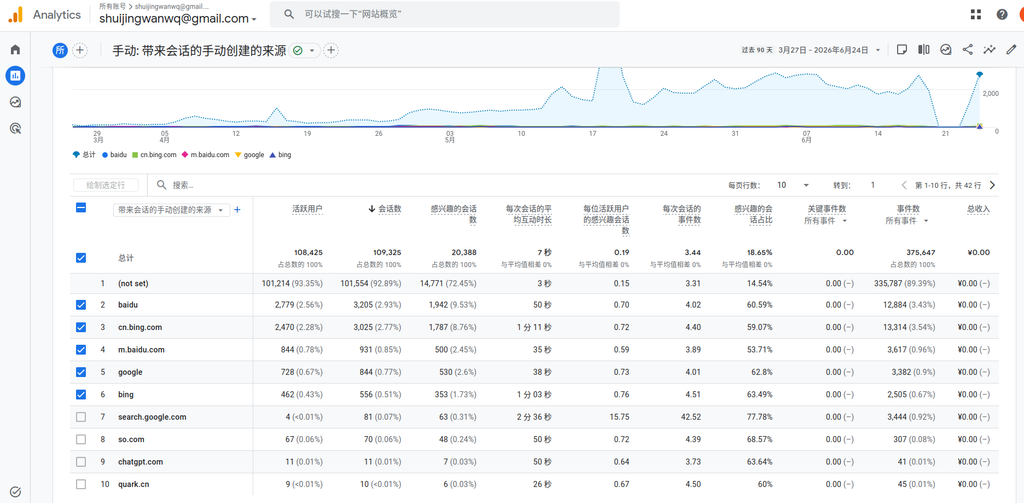
- Google Analytics traffic source data for the last 90 days;
- Google Search Console page data for the last 90 days;
- Bing Webmaster page traffic data for the last 90 days;
- Bing Webmaster keyword data for the last 90 days;
- Baidu Tongji data for the last 90 days, including traffic sources, external links, search terms, and visited pages.
It should be noted that while switching to a new WordPress theme recently, I spent about 5 days adjusting the page layout and features without promptly re-adding the tracking code. Consequently, both Google Analytics and Baidu Tongji have missing data for those 5 days.
Therefore, the conclusions in this article do not claim absolute precision; rather, they serve to identify trends and determine future operational directions.


2. Why Relying Solely on Google Analytics Is Not Enough
A significant portion of my website readers comes from mainland China, where Google Analytics is not reliably accessible.
Often, after a user opens a page, the Google Analytics request remains pending or even fails completely. This causes actual visits to go unrecorded.
Therefore, I now prefer to divide the analytics workload as follows:
| Tool | Primary Use |
|---|---|
| Google Analytics | Overall traffic source trends and user behavior |
| Google Search Console | Google search performance |
| Bing Webmaster | Bing search performance |
| Baidu Tongji | Actual visits from China and Baidu-side traffic |
Moving forward, I cannot rely on a single analytics tool; I must cross-reference multiple platforms for a comprehensive assessment.
3. Traffic Source Structure: Bing Is Becoming Increasingly Important
According to the last 90 days of data from Google Analytics, among known sources:
| Source | Sessions |
|---|---|
| Baidu-related | 4136 |
| Bing-related | 3581 |
| Google-related | 931 |
Looking at the 90-day window, Baidu still slightly exceeds Bing.
However, the data I observed for the last 30 days is:
| Source | Sessions |
|---|---|
| cn.bing.com | 1158 |
| Baidu | 848 |
| 371 |
That is, Bing has recently surpassed Baidu.
This is likely related to my recent submission of a sitemap in Bing Webmaster Tools.
This gives me the following insight:
Going forward, blog operations cannot focus solely on Google SEO; Bing is also worth maintaining seriously.
For tech blogs in particular, Bing might respond to new content and new sitemaps faster than Google.
4. “External Links” in Baidu Tongji Must Also Be Included in Search Analysis
In Baidu Tongji, the overall traffic source data for the last 90 days is as follows:
| Source Type | PV | Share |
|---|---|---|
| Direct Access | 16587 | 58.4% |
| External Links | 6776 | 23.8% |
| Search Engines | 5042 | 17.7% |
| Custom Sources | 12 | 0.0% |
Initially, I assumed that “Search Engines” represented all search traffic. However, after examining the “External Links” section further, I found that it contains a large volume of search engine traffic.
For example:
| External Link | PV |
|---|---|
| cn.bing.com | 4927 |
| www.bing.com | 745 |
| m.baidu.com | 513 |
| baidu.com | 218 |
| www.baidu.com | 98 |
| chatgpt.com | 85 |
| search.google.com | 47 |
Here, cn.bing.com + www.bing.com total 5672 PV, accounting for 83.7% of external link sources.
Therefore, “External Links” in Baidu Tongji cannot simply be interpreted as ordinary backlinks. For my website, it includes a significant amount of search engine traffic.
When analyzing search traffic moving forward, I should combine:
Search Engines + Search-type External Links
and evaluate them together.
5. Currently Most Valuable Keyword Directions
Based on keyword data from Bing Webmaster, VPN / WireGuard related keywords show very distinct performance:
| Keyword | Impressions | Clicks | Avg. Position |
|---|---|---|---|
| wireguard | 13673 | 434 | 6.14 |
| wireguard vpn | 371 | 38 | 4.13 |
| vpn搭建 | 251 | 24 | 4.44 |
| 自建vpn | 230 | 29 | 3.74 |
| wireguard 配置 | 200 | 12 | 6.52 |
This dataset is crucial.
It does not represent generic traffic, but rather search traffic driven by specific problem scenarios.
Users searching for WireGuard, VPN setup, or self-hosted VPNs are highly likely doing one of the following:
- Preparing to purchase a server;
- Preparing to deploy a VPN;
- Encountering configuration issues;
- Comparing commercial VPNs with self-hosted VPNs;
- Potentially willing to pay someone for deployment assistance.
Therefore, the commercial value of this type of content is significantly higher than that of ordinary technical notes.
6. Current High-Value Pages
Looking comprehensively at Baidu Tongji, Google Search Console, and Bing Webmaster, the following types of pages warrant priority attention.
1. VPN / WireGuard Series Articles
These articles simultaneously meet the criteria of:
- High search traffic;
- Strong commercial intent in keywords;
- Suitability for naturally integrating VPS / VPN affiliate links;
- Potential to drive consulting services.
These are the top priority moving forward.
2. Linux / Ubuntu / System Environment Articles
These articles are suitable for placing:
- VPS affiliate links;
- Server tools;
- Linux operations consulting CTAs.
Although the conversion rate per article might not be as high as VPN-related content, the audience reach is broader.
3. AI Tools / ChatGPT Articles
These articles are suitable for placing:
- ChatGPT Plus subscription plans;
- Claude subscription plans;
- AI tool invite codes;
- BeWild invitation links.
This area still has room for growth in the future, especially once the English articles start getting indexed by search engines.
4. WordPress / Blog Operations Articles
These articles are suitable for placing:
- Hosting affiliate links;
- WordPress plugins;
- Themes;
- Blog monetization services;
- Internal links to AdSense / SEO experience articles.
This section may not generate immediate revenue, but it is suitable for building long-term personal brand equity.
7. The English Site Is a Key Variable for the Next 3 to 6 Months
Starting May 20, 2026, I began translating Chinese articles into English on a large scale. This process lasted for about a month.
Currently, the translation of historical Chinese articles into English is mostly complete. Moving forward, I will also try to translate newly written Chinese articles into English on the same day.
This will significantly impact the future traffic structure.
Because:
- Google has a larger search volume for English technical content;
- Bing might also be more favorable towards English pages;
- VPNs, VPS, and AI tools are inherently global products;
- English traffic is more suitable for affiliate marketing;
- English readers show a higher acceptance rate for subscription-based tools and SaaS products.
Therefore, this report only represents the current stage.
Over the next 3 to 6 months, the proportion of English site traffic may continue to rise.
This is also one of the main reasons I am starting to establish an affiliate marketing strategy now.
8. Revenue Structure Should Shift from “Ads First” to “Consulting + Affiliate + Ads”
In the past, I primarily considered two revenue streams for the blog:
AdSense + Consulting Services
However, based on this data, a more reasonable structure should be:
Consulting Services + Affiliate Marketing + AdSense
The priorities are as follows:
First Priority: Consulting Services
Specifically:
- Remote VPN deployment;
- Linux operations and maintenance;
- PHP / Go technical consulting;
- WordPress maintenance;
- System performance optimization.
Consulting services offer the highest unit price and represent the revenue method that best reflects the value of personal experience.
Second Priority: Affiliate Marketing
This is suitable for capturing readers who “do not want consulting, but are willing to do it themselves.”
For example:
- Buying a VPS themselves;
- Purchasing a VPN themselves;
- Subscribing to AI tools themselves;
- Trying out server tools themselves.
These users might not pay for consulting, but they can generate revenue through affiliate links.
Third Priority: Ad Revenue
AdSense will remain active, but it should not be the core revenue source.
Ads are suitable for covering long-tail traffic that cannot be directly converted, but the reading experience must not be compromised for the sake of ads.
9. Phase One Layout for Affiliate Marketing
I do not plan to apply to a large number of affiliate platforms right from the start.
The first phase will focus exclusively on existing high-value content.
1. VPS Affiliate Programs
Best suited for placement in:
- WireGuard tutorials;
- Self-hosted VPN tutorials;
- Linux server tutorials;
- Ubuntu server tutorials;
- Wstunnel / Clash / VPS deployment articles.
Platforms to consider:
- Vultr;
- DigitalOcean;
- Linode / Akamai;
- Hetzner;
- RackNerd;
- LightNode.
Placement method:
The test environment in this article uses the Vultr Singapore node. If you do not yet have a server, you can register through my referral link.
This phrasing acts as an environment description rather than a hard sell, leading to higher reader acceptance.
2. VPN Service Affiliate Programs
Suitable for placement in:
- Self-hosted VPN comparison articles;
- Commercial VPN review articles;
- VPN solution selection articles;
- At the bottom of WireGuard series articles.
ZoogVPN has already proactively contacted me, so it can serve as the first test candidate.
However, whether I recommend it cannot depend solely on the commission rate; I must first test:
- Usability in mainland China;
- Speed;
- Stability;
- Client experience;
- Refund policy;
- Whether it supports promotion on the Chinese site;
- Whether an exclusive discount code can be provided;
- Whether it is suitable for my readers.
If the test results are good, I will write an independent review.
If the test results are average, it can only be listed as an optional solution, not a strong recommendation.
3. AI Tools Affiliate Programs
Suitable for placement in:
- ChatGPT Plus subscription articles;
- Claude usage articles;
- AI tool practice articles;
- Tech blog AI transformation articles.
Currently, the BeWild invitation link can be prioritized.
However, placement must also be natural, for example:
If you find it inconvenient to subscribe to ChatGPT Plus directly, you can check out the third-party subscription plan that I have actually used.
4. WordPress / Blog Tools Affiliate Programs
This section is not a top priority for now.
The reason is that the strongest commercial intent currently remains with VPN / VPS / AI tools.
But in the medium to long term, I can consider:
- Hosting;
- Themes;
- Plugins;
- SEO tools;
- Email subscription tools.
10. Guidelines for Placing Affiliate Links Within Articles
To prevent the blog from turning into an ad site, I will adhere to the following principles moving forward.
1. Only Place Affiliate Links on Relevant Pages
Do not force them across the entire site.
For example:
- Place VPS / VPN links in WireGuard articles;
- Place AI subscription links in ChatGPT articles;
- Place hosting / plugin links in WordPress articles;
- Place VPS / operations service links in Linux articles.
2. Prioritize Writing “Usage Environment” Rather Than “Highly Recommended”
Not recommended:
Highly recommend buying Vultr!
More recommended:
The test environment for this article uses the Vultr Singapore node. Other VPS providers work too, as long as they support Ubuntu.
3. Clearly Label as Affiliate
I suggest adding a standard disclaimer:
Note: Some links are affiliate links. If you register or purchase through these links, I may earn a commission at no extra cost to you. This article still relies on actual user experience and technical feasibility as its primary evaluation criteria.
4. Retain Consulting Service Entry Points
Affiliate links target those willing to do it themselves.
Consulting services target those who do not want the hassle.
The two do not conflict.
For the VPN series articles, the bottom should still retain:
- Remote deployment assistance;
- Self-hosted VPN consulting;
- Free trials for self-hosted nodes;
- Long-term maintenance support.
11. 90-Day Execution Plan
Phase 1: Revise 10 High-Value Articles First
Prioritize the articles with the highest traffic related to VPN / WireGuard / VPS.
For each article, I will only do three things:
- Add experimental environment details;
- Insert VPS / VPN affiliate links;
- Retain the consulting service CTA.
Do not modify the entire site all at once.
Start with 10 articles and observe for 30 days.
Phase 2: Build a Resource Recommendation Page
Create a new page:
My Long-Term Recommendations for VPS, VPN, and AI Tools
Consolidate the following on the page:
- VPS;
- VPN;
- DNS;
- SSH tools;
- AI subscriptions;
- WordPress tools.
From now on, all related articles can link naturally to this page.
Phase 3: Test ZoogVPN
Do not write a strong recommendation article immediately.
Testing dimensions include:
- Windows;
- Android;
- Linux;
- Access stability in mainland China;
- ChatGPT usability;
- YouTube speed;
- Performance during peak hours;
- Refund process;
- Customer service responsiveness.
After testing is complete, I will decide whether to write an independent review.
Phase 4: Establish an Affiliate Link Tracking Sheet
Every affiliate link must be tracked with:
| Field | Description |
|---|---|
| Brand | e.g., Vultr, ZoogVPN, BeWild |
| Placement Page | Which article |
| Placement Position | Top, middle, bottom, resource page |
| Placement Date | For future review |
| Clicks | For future tracking |
| Registrations | For future tracking |
| Commission | For future tracking |
| Keep or Remove | Review decision |
Do not keep links long-term based on gut feeling.
Everything should be driven by data review.
12. Conclusions from This Analysis
This data analysis confirmed one thing for me:
My tech blog is no longer just a content repository tool; it has the foundation for commercial operations.
The VPN / WireGuard / VPS direction, in particular, simultaneously possesses:
- Search traffic;
- Clear user needs;
- High commercial intent;
- Potential for consulting conversions;
- Affiliate marketing opportunities.
Moving forward, I will not drastically increase ad placements for revenue, nor will I turn the blog into an ad site.
The path more suited to me is:
Authentic technical practice content + natural affiliate recommendations + high-value consulting services + minimal display ads.
This path is slower, but it is more appropriate for a long-term personal tech blog.
I will use this analysis as the first version of my operational guide. I will start with the VPN / WireGuard / VPS series to test affiliate marketing effectiveness on a small scale, and then decide based on data whether to expand to AI, WordPress, Linux operations, and other directions.
The first phase of the blog was about consistent writing and accumulating technical knowledge.
From now on, I want it to enter its second phase:
Capitalizing content, commercializing traffic, and building a long-term personal brand.