

🧭 1. Background: Why I Needed to Address SEO Issues on Tag Pages
While operating the website, I gradually noticed a clear issue:
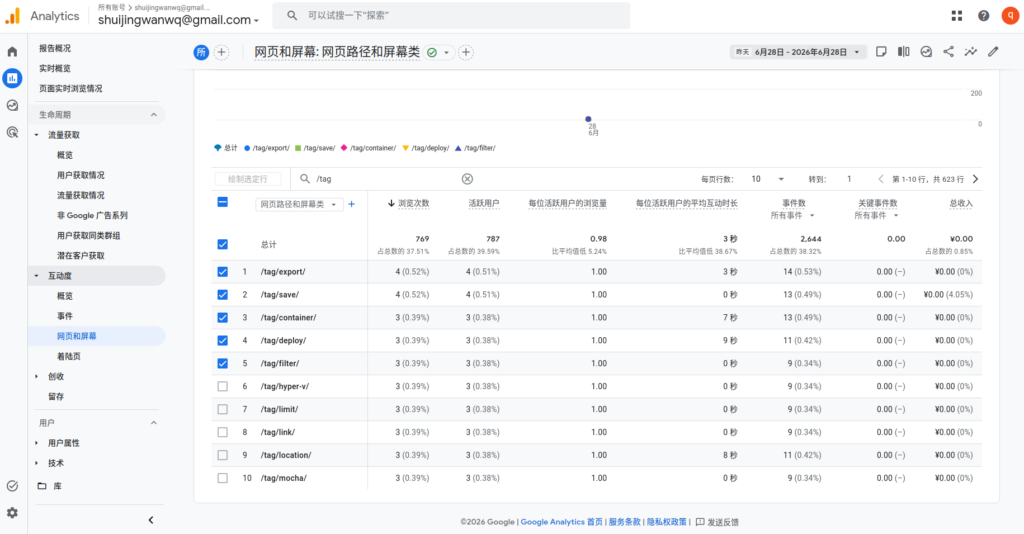
/tag/pages show a massive amount of “0-second visits” and low engagement data in GA4.
Further analysis revealed:
- An enormous number of tag pages (over 16,000 combined across Chinese and English versions)
- Some tag pages contain only 1–2 articles
- A large number of low-content pages are indexed by search engines
- This severely dilutes the overall SEO data
This ultimately leads to the following problem:
❗ “Uneven index page quality → polluted traffic structure → dragged-down average engagement time”

🧪 2. The Core Issue: Not Content, but Index Structure
Through GA4 and page analysis, I confirmed:
- Article pages themselves have normal engagement
- tag / archive pages provide numerous low-quality entry points
- “0-second visits” mainly originate from tag pages
Therefore, the core issue is:
🧠 Overexpansion of the SEO index structure, rather than insufficient content quality
⚙️ 3. Initial Solution: Tag noindex Control via WPCode
My initial approach was:
👉 Automatically add noindex when a tag has fewer than 2 articles
The code is as follows:
/**
 * 为文章数小于2的薄内容标签页添加 noindex 标签
 * 直接输出到页面头部(通过wpcode Site Wide Header实现)
 */
// 不是标签页直接返回
if ( !is_tag() ) {
    return;
}

// 获取当前标签对象,不存在则返回
$tag = get_queried_object();
if ( !$tag || !isset( $tag->count ) ) {
    return;
}

// 判断文章计数小于2
if ( $tag->count < 2 ) {
    echo '<meta name="googlebot" content="noindex, follow">' . "\n";
    echo '<meta name="robots" content="noindex, follow">' . "\n";
}
🔄 4. Optimization: Adjusting the Threshold to 3 + Execution Structure Optimization
After further analysis, I adjusted the strategy to:
✔ Apply noindex only when a tag page has < 3 articles
I also upgraded the execution method by switching to a standard WordPress hook:
add_action('wp', function () {

    if ( !is_tag() ) {
        return;
    }

    $tag = get_queried_object();

    if ( !$tag || !isset($tag->count) ) {
        return;
    }

    $threshold = 3;

    if ( (int)$tag->count < $threshold ) {

        add_action('wp_head', function () {
            echo "\n<meta name=\"robots\" content=\"noindex, follow\">\n";
        });

    }

});
📌 5. Execution Environment Setup
Configured in WPCode as follows:
- Snippet Type: PHP Snippet
- Location: Frontend Only
- Auto Insert: Enabled (executed site-wide on the frontend)
🧠 6. Key Pitfalls and Lessons Learned
During this optimization process, I gathered several key takeaways:
❗ 1. Do Not Rely Directly on the Site Wide Header
This approach has the following issues:
- Unstable execution context
- Risk of mixing PHP/HTML
- SEO meta output may be unreliable
❗ 2. The WordPress Lifecycle is Critical
You must ensure that:
- is_tag() is initialized
- The query is complete
- wp_head fires correctly
❗ 3. noindex Does Not Equal SEO Loss
A common misconception is:
❌ noindex reduces traffic
The reality is:
🟢 It improves the “concentration of effective page authority”
📉 7. Expected Optimization Results
This adjustment primarily brings:
- Reduced indexing of low-quality tag pages
- Improved concentration of authority on article pages
- Lower proportion of 0-second visits in GA4
- Improved accuracy of average engagement time
🚀 8. Conclusion
The core of this optimization is not “SEO boost,” but rather:
🧠 “Cleaning up search engine index structure noise, allowing real content to regain primary authority”
📌 Final Strategy
The current stable strategy is as follows:
- tag < 3 → noindex
- Article pages → keep index
- category / archive → no action for now
- Monitor data changes over the next 7–14 days