

When testing an overseas network service aimed at users in mainland China, many people immediately focus on:
- Whether it can connect successfully
- Whether it can access Google / YouTube / ChatGPT
- Whether the speed is fast
- Whether it supports WireGuard
- Whether it supports obfuscation protocols
But when testing Zoog this time, I found a more fundamental issue:
Under real network conditions in mainland China, can users successfully open the registration page and complete account registration?
This step seems simple, but for this type of network service, it is actually crucial.
If users cannot access the registration entry point before purchasing or trying the service, then the subsequent product experience, protocol support, and speed performance will never have a chance to occur.
1. Test Background
Recently, while discussing an affiliate partnership with Zoog, they mentioned:
- Zoog supports a one-click usage experience for regular users
- For the mainland China network environment, it provides a Shadow protocol with obfuscation
- It supports accessing international services like ChatGPT, Google, and YouTube
- It also supports WireGuard and can provide raw configuration files
- However, WireGuard may be affected by DPI in the mainland China network environment, and the official recommendation is to use the built-in Shadow protocol in the App
In terms of product positioning, Zoog is not primarily aimed at developers building their own environments, but leans more toward regular users:
Download App → Log in to account → Select protocol → One-click connect
Therefore, I decided to start testing from the most realistic path for a regular user.
2. Test Objectives
This test does not directly measure connection speed, but first verifies the initial stage:
Can a regular user in mainland China successfully open the Zoog registration page under a standard network environment?
The test entry point is:
https://app.zooog.info/sign-up
The test focuses on:
- Whether the registration page can be opened on mobile
- Whether the registration page can be opened on desktop
- Whether registration can be completed under a standard network environment
- Whether access and registration work normally after switching network environments
3. Test Environment
This test attempts to simulate the real usage conditions of mainland China users:
- Maintain a standard mainland China network environment
- Use regular mobile networks / WiFi networks
- Test separately using mobile and desktop browsers
- Test the standard network condition first, then test the condition after switching network environments
The reason for this is:
Users who truly need this type of network service are usually still in a standard network environment before purchasing or registering.
If the registration entry point for a network service itself requires switching network environments just to open, this becomes a very obvious barrier to registration conversion.
4. Mobile Test Results: Both Devices Failed to Open Properly
I tested the Zoog registration page on two different mobile devices, and the results were unsatisfactory.
One of the mobile pages displayed the following prompt:
Unable to open page
Error message: ERR_CONNECTION_TIMED_OUT
Tap screen to reload
As shown in Figure 1:

On the other mobile device, the top of the page showed that app.zooog.info had started loading, but the main body of the page remained blank for a long time, preventing access to the actual registration page.
As shown in Figure 3:

From the mobile performance, it is highly likely that users cannot smoothly enter the registration process under a standard mainland China network environment.
5. Desktop Test Results: Timeouts in Some Environments, Opens in Others but Registration Unresponsive
During desktop testing, instability also occurred.
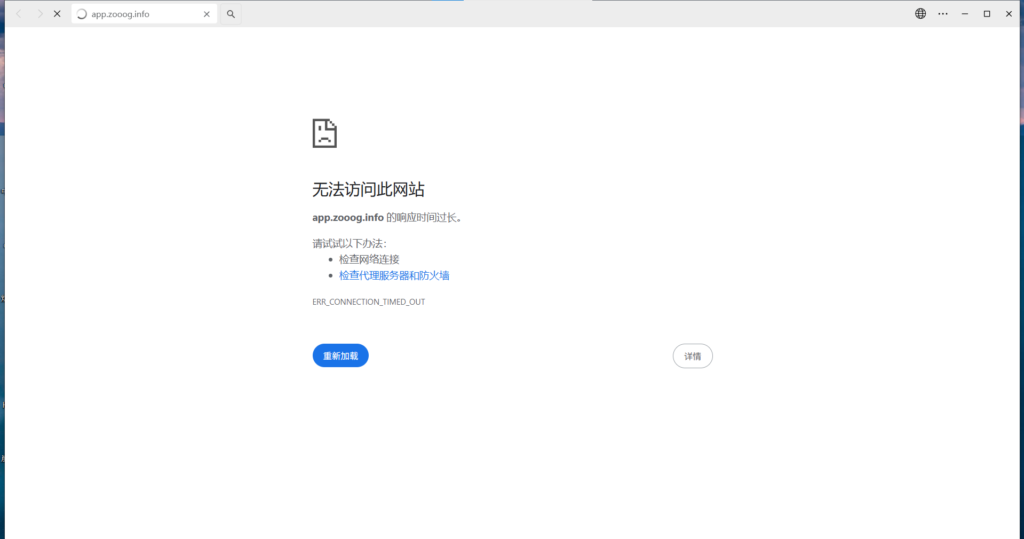
In one desktop browser, accessing app.zooog.info prompted:
This site can’t be reached
app.zooog.info took too long to respond
ERR_CONNECTION_TIMED_OUT
As shown in Figure 2:
In another desktop environment, the page could open, but clicking the registration button yielded no obvious response, and the registration process could not be completed.
This indicates that the problem is not just “mobile browser compatibility,” but rather an overall access stability issue with the registration entry point in the mainland China network environment.
6. Test After Switching Network Environments: Page and Registration Process Restored to Normal
Subsequently, I switched network environments and accessed the same registration link on the desktop again.
This time:
- The page opened normally
- The registration button responded normally
- The registration process could be completed smoothly
This shows that the Zoog registration page itself is not completely unavailable, but rather:
Under a standard mainland China network environment, the access link experiences significant blocking or instability.
7. Core Issue: Users Get Stuck at the First Step Before Even Using the Product
The most crucial finding of this test is not “whether the product itself is easy to use,” but rather:
Users may be unable to complete registration before they ever truly interact with the product.
For this type of network service, this issue is very important.
Because the complete conversion path for a regular user is usually:
- Search for related network services
- Open the official website or registration entry point
- Register an account
- Download the client
- Log in to the App
- Select protocol
- Successfully connect for the first time
- Start using Google / ChatGPT / YouTube
However, under the mainland China network environment at the time, Zoog might experience issues at step 2 or step 3:
The registration entry point cannot be opened, or registration cannot be completed after opening.
This directly affects:
- New user registration conversion rate
- Affiliate promotion conversion rate
- First-time experience for mainland China users
- Product reachability in restricted network environments
8. This Is Not a Product Feature Issue, but an Entry Point Reachability Issue
It should be specifically noted that this test cannot directly conclude that “Zoog is unavailable in mainland China.”
A more accurate conclusion would be:
Zoog’s registration entry point has access barriers under real mainland China network conditions, which may cause user churn before they even use the product.
In other words, this is more of a:
- Access entry point issue
- Registration funnel issue
- Distribution link issue
- Mainland China user onboarding issue
Rather than an issue with the Shadow protocol, client connection capability, or node quality itself.
These still need further testing after the account is successfully registered and Premium is activated.
9. Impact on Affiliate Promotion
From an affiliate marketing perspective, this issue directly impacts conversion.
Because affiliate links usually ultimately guide users to the registration or purchase page.
If, after clicking the link, the user experiences:
- The page not opening
- Page loading timeout
- Unresponsive registration button
- The need to switch network environments before registering
Then, no matter how well-written the article content is, a large number of potential users could be lost at the very first step.
For recommendation content regarding overseas network services aimed at mainland China users, this is an issue that must be verified in advance.
10. Possible Optimization Suggestions for Zoog
Based on the test results at the time, if Zoog wishes to better serve mainland China users, they might need to consider the following directions:
1. Provide an alternative registration entry point accessible in mainland China
For example:
- Alternative domains
- Mirrored registration pages
- Lightweight registration pages
- Entry pages specifically for restricted regions
2. Provide offline methods to obtain the client installation
For users unable to open the official website, consider providing:
- Alternative download links
- Email delivery of installation packages
- Telegram / GitHub / CDN mirror downloads
- Alternative Android APK download methods
3. Optimize the affiliate user path
If affiliate promotions target mainland China users, it is best not to provide only a single main registration link.
A more ideal approach would be:
Article entry point → Accessible landing page → Registration instructions → Alternative downloads → In-app Shadow protocol connection
This makes the user path more complete.
11. Current Stage Conclusion
The phased conclusions of this test are as follows:
| Test Item | Result |
|---|---|
| Accessing registration page on mobile under standard network environment | Failed / Timed out |
| Accessing registration page on desktop under standard network environment | Unstable / Timed out |
| Clicking registration on desktop under standard network environment | Unresponsive in some cases |
| Accessing registration page on desktop after switching network environment | Success |
| Completing registration on desktop after switching network environment | Success |
Therefore, a fairly cautious conclusion can currently be drawn:
Zoog has a clear access barrier at the registration entry stage for mainland China users. For new users who do not yet have another available network entry point, they may be unable to enter the registration process before they even start testing the product.
Update: Zoog Has Since Provided a New Entry Point for Chinese Users
On July 28, 2026, I received an official response from Zoog regarding the previous access test. The official team confirmed that accessibility under mainland China network conditions is indeed an ongoing concern for them, and stated that they would maintain recommended entry points based on changes in the network environment.
Subsequently, I also confirmed in the Zoog Affiliate Dashboard that the backend now provides a separate promotional entry point specifically for Chinese users.
Therefore, the test conclusion from July 3, 2026, in this article remains valid: the original registration entry point used during testing had clear access barriers under the mainland China network environment. However, as of now, Zoog has provided a new entry point for Chinese users, and the situation has changed compared to the initial test.
Currently, you can view the official product and service information provided through the Zoog currently recommended entry point.
I have compiled another article regarding this official response and subsequent changes: Follow-up on Zoog Mainland China Access Testing: Official Confirms Access Challenges and Provides Current Recommended Entry Point.
12. Follow-up Test Plan at the Time
After completing the first round of testing on July 3, 2026, I reported this issue to the official Zoog partnership contacts.
At that time, I planned to decide whether to continue testing based on whether they could provide the following:
- A more stable registration entry point
- Alternative links accessible in mainland China
- A Premium test account
- Alternative client download methods
- Onboarding suggestions for Chinese users
If the entry point issue improves, the subsequent content more worth testing includes:
- Connection success rate of the Shadow protocol under mainland China network conditions
- ChatGPT access stability
- Google / YouTube loading speed
- Windows / Android client experience
- Differences compared to self-built WireGuard / Clash solutions
- Whether regular users can truly achieve “out-of-the-box” usability
13. My Thoughts
The biggest reminder this test gave me is:
The core experience of this type of network service is not just “whether it works after connecting,” but also “whether the user can smoothly start using it.”
For mainland China users, the access link itself is part of the product experience.
If a service’s registration page, download page, and login page cannot be accessed stably, then no matter how strong its product capabilities are, it will be difficult for regular users to truly experience them.
Therefore, before recommending any such network service, I believe at least three things should be verified first:
- Whether mainland China users can open the registration entry point
- Whether they can smoothly download the client
- Whether they can complete the initial connection without complex configuration
These three questions are closer to the real experience of regular users than simply testing speed.